
The Muscle Groups section shows how much you are training each muscle group. You can see how many sets you complete and how much total work each muscle group receives over time. This makes it easier to identify whether certain muscle groups may be receiving too much or too little training.
For example, you might see via the data that your biceps receive more volume than you expected, while your quads receive much less. With this information, you can use the Muscle Groups section to make adjustments to your training program if you’re concerned about having a more balanced program.
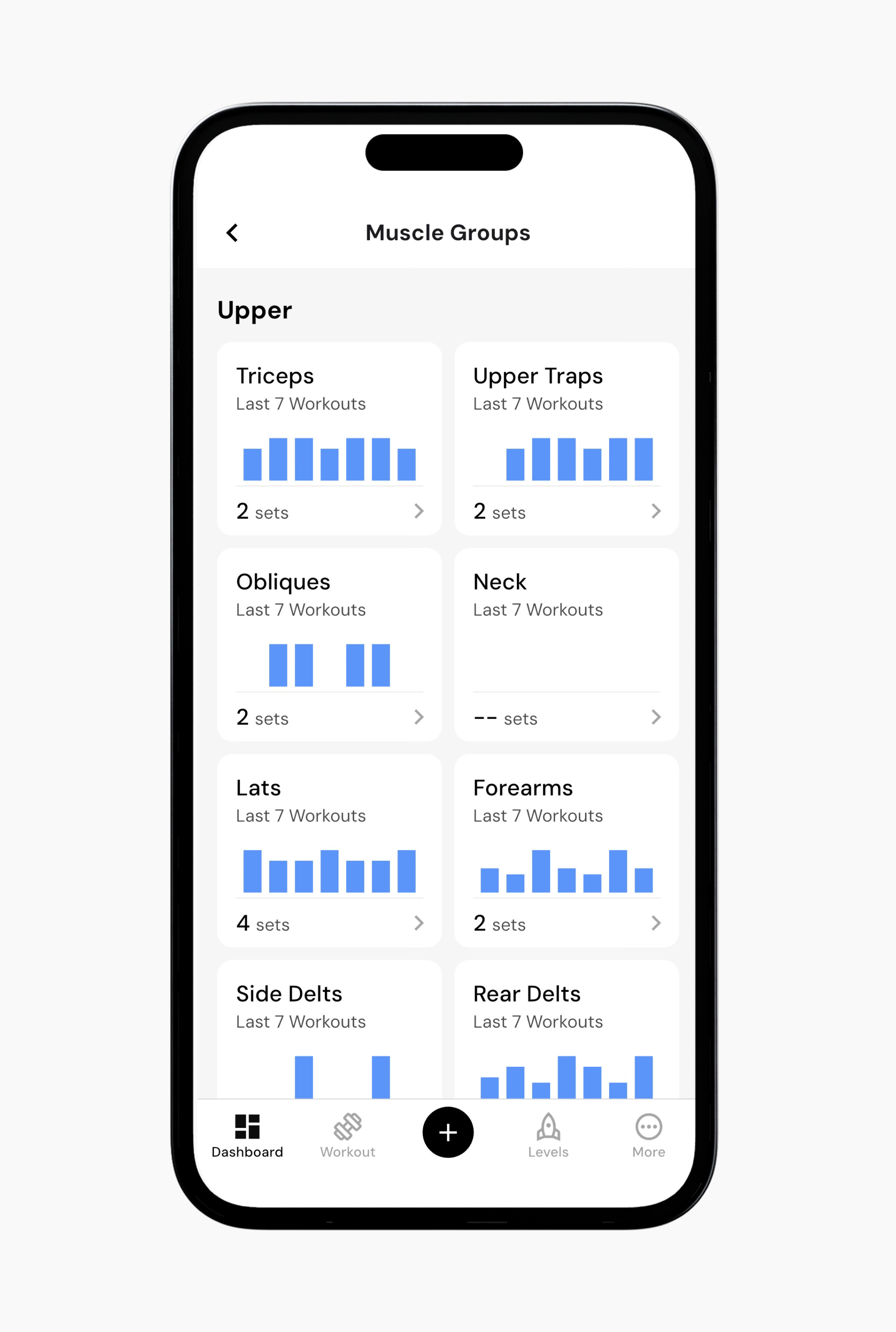
Sets over time
The Sets view shows how many sets each muscle group receives over time. It includes sets completed in individual workouts as well as the total number of sets accumulated across the selected time range. Since sets are a major contributor to training stimulus, this view helps put changes in progress into context. For example, if progress has stalled, this view can help you see whether that period lines up with a drop in total sets or training frequency.
Below the chart, you can also view individual training sessions for the selected time range.
Volume over time
The Volume view shows how the total amount of training volume for each muscle group changes over time. This view reflects the overall amount of work a muscle group is performing.
Unlike the Sets view, the Volume view accounts for how heavy those sets are. This makes it useful for understanding changes in workload when training intensity shifts over time.
The chart also separates volume into two types: resistance-based volume and bodyweight volume. Resistance-based volume reflects work performed with external load, such as barbells, dumbbells, or machines. Bodyweight volume reflects work where your body is the primary load, such as pull-ups, push-ups, or dips. In this context, separating volume types could, for example, help explain why a muscle group’s workload changes even when total sets stay the same.
Overall, this data helps you spot trends so you can make more informed decisions about your training over time.
Read next:
Now that you’ve learned about muscle groups, you might enjoy one of these articles next:
Exercise Overview
Add or Remove Exercises to a Program
Understanding Levels